
DP World finally paying some tax in Australia but still putting workers jobs "in the crosshairs".
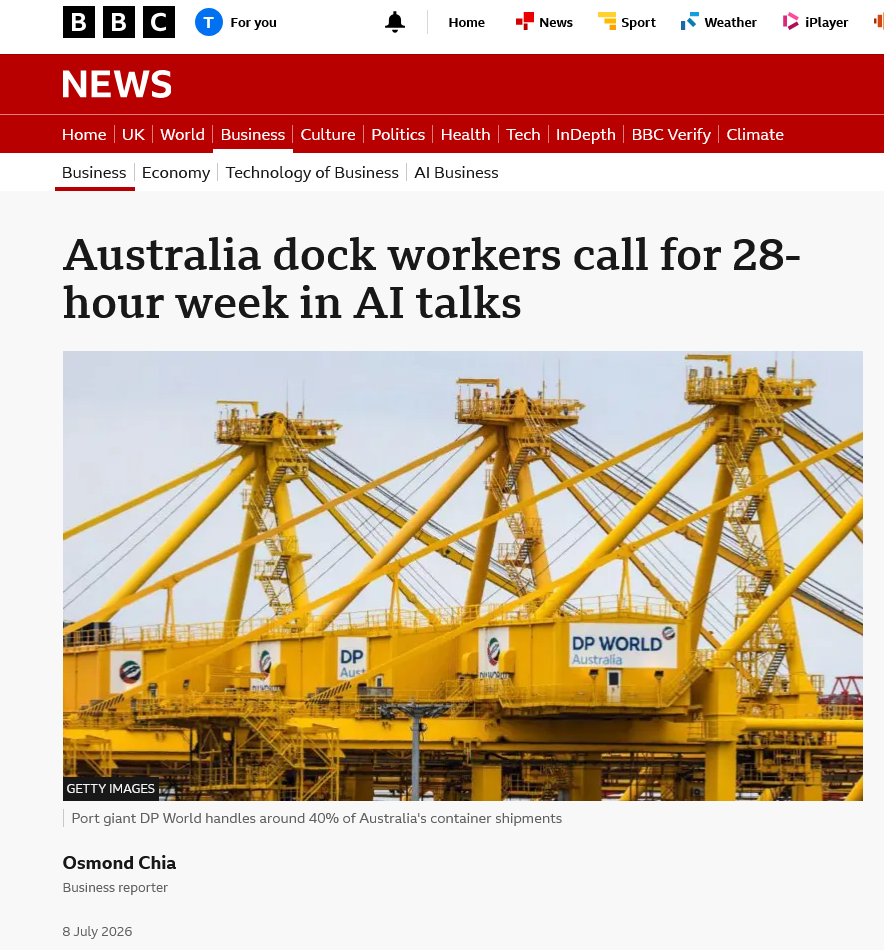
BBC article on MUA and DP World
In a recent interview with ABC’s ‘Canberra Mornings’ program, CICTAR Principal Analyst, Jason Ward, discusses the most recent Australian Tax Office (ATO) data on corporate tax payments.
This data has been made easily available through a collaborative project by CICTAR, the Tax Justice Network – Australia, and researchers from the University of Technology Sydney (UTS) Business School.
As well as discussing the ways in which various global corporations are able to avoid paying tax, through strategic structuring and profit shifting, Jason highlighted the way in which Australia is leading the world on tax transparency, with a new set of public data due later this year which will help to show whether genuine business operations align with where profits are booked and taxes are paid by corporations globally.
CICTAR may be able to take some credit for at least one notable recent change in the data: Global Port Giant, DP World’s increased payment in 2024 and 2025. Before our reporting on DP World’s finances in Australia started, DP World was paying no tax, despite posting very healthy income. From 2024 onward the data shows the corporation paying significant (if still insufficient) levels of corporate income tax!
Meanwhile, a BBC article from July reports on how CICTAR partner, the Maritime Union of Australia, is pushing back against the automation programme being rolled out by DP World. The MUA is calling out the corporation for a pattern of pushing AI into operations "without genuine consultation".
The BBC article references the CICTAR study, developed with MUA and published earlier this year, which showed that, despite a decade of revenue and profit margin growth DP World’s contribution to Australia’s tax base, up to 2024, had been severely lacking. At the same time, the corporation was attempting to embark on an ambitious AI automation programme that could threaten up to a thousand jobs or over 60% of the wharfie and maintenance workforce. The union is now demanding a 28-hour work week with no loss of pay, saying that the new technology doesn't have to cost members jobs or put livelihoods at risk.
CICTAR has carried out research and published a number of pieces on DP World over the last few years, in support of unions and communities in Australia, Canada and New Zealand. In Australia our 2024 report, developed in partnership with the MUA highlighted how DP World, one of Australia’s two largest port operators, had, at that time, paid no tax in Australia despite generating revenue of more than $4.5bn over eight years. This report was just one component of a powerful campaign against DP World by MUA, which resulted in a successful wage settlement.
In New Zealand, our work helped fend off an aggressive bid by a DP World-led consortium to operate and develop Lyttelton Port while in Canada we have supported local unions in Vancouver in their dispute with DP World, raising awareness of the failures of the company to pay tax elsewhere in the world and challenging it to be transparent about its tax affairs locally. Recently, in Vancouver Canada, a group of maritime unions from North America, Australia and Aotearoa issued joint statement on DP World and the global struggle of dockers facing AI and automation.
As AI, linked with increasing, automation begins to bite globally, and across different sectors, the fight back against DP World may provide some valuable lessons for unions setting up campaigns of resistance.